

Automotive engineering and product development consulting
We deliver end-to-end automotive engineering that accelerates development from concept to production-ready systems, optimising performance and robustness through our Robust Design ecosystem and tools. Our expertise supports automotive engineering teams that need predictable system behaviour, faster validation, and seamless integration into existing manufacturing processes.

We work with the best companies






What is mechanical engineering consulting for automotive systems?
In practice, this means defining system kinematics and load paths, controlling tolerances and interfaces, and validating performance under realistic manufacturing variation. The focus is on exposing risks early, reducing redesign loops, and ensuring durability, functional performance, assembly feasibility, and cost targets are met together.
The challenges we address are familiar in automotive programmes: long development cycles, late discoveries, overconstrained designs, and excessive rework. By linking design decisions directly to functional behaviour and production reality, we shorten development time and keep cost and timing under control.
What sets us apart from generic mechanical engineers is our Robust Design, system level approach and production focused mindset. Instead of optimising individual parts, we engineer complete automotive systems that are robust, scalable, withstand real road environments, and are ready for high volume manufacturing.
Automotive System Engineering and Development
Automotive System Engineering and Development is the structured execution of mechanical engineering across complete vehicle systems, ensuring that function, performance, durability, and manufacturability are designed in from the start.
In practice, it involves defining clear system architectures, interfaces, load paths, and requirements, then translating them into robust, production-ready designs using data-driven methods, thereby minimizing risk in production and use.

Robust Design, Variation Control, and Cost Efficiency
RD8 focuses on making automotive systems insensitive to manufacturing variation while meeting performance and durability targets at scale. This involves early tolerance allocation, clear kinematics, and structural assessment of interfaces and load paths, so critical functions remain stable across millions of units.
By embedding robustness into the design rather than relying on late fixes, engineering risk is reduced, production yield improves, and total cost is lowered without compromising vehicle performance.
Concept-to-High-Volume Production Support
Concept-to-Production Development Support ensures automotive systems are engineered with a clear path from early concepts to stable, high-volume manufacturing.
What this means in practice is, that it connects requirements, design decisions, validation, and production constraints into a single, structured engineering flow.
This reduces late changes, and ensures that performance, time, and cost targets are met consistently when designs move from prototype to series production.

What types of automotive systems does rd8 support?
Interior Modules
Interior modules combine multi-material structures, tight kinematics and visible interfaces where perceived quality is critical. They rely on precise constraint design and controlled tolerance stacks to avoid noise, rattle and inconsistent feel.
Development is challenged by high sensitivity to variation, complex assembly sequences and conflicting requirements between cost, aesthetics and robustness.
RD8 supports interior modules through kinematic analysis, interface optimization and tolerance optimisation, leading to predictable behaviour and first-time-right designs ready for high-volume production.

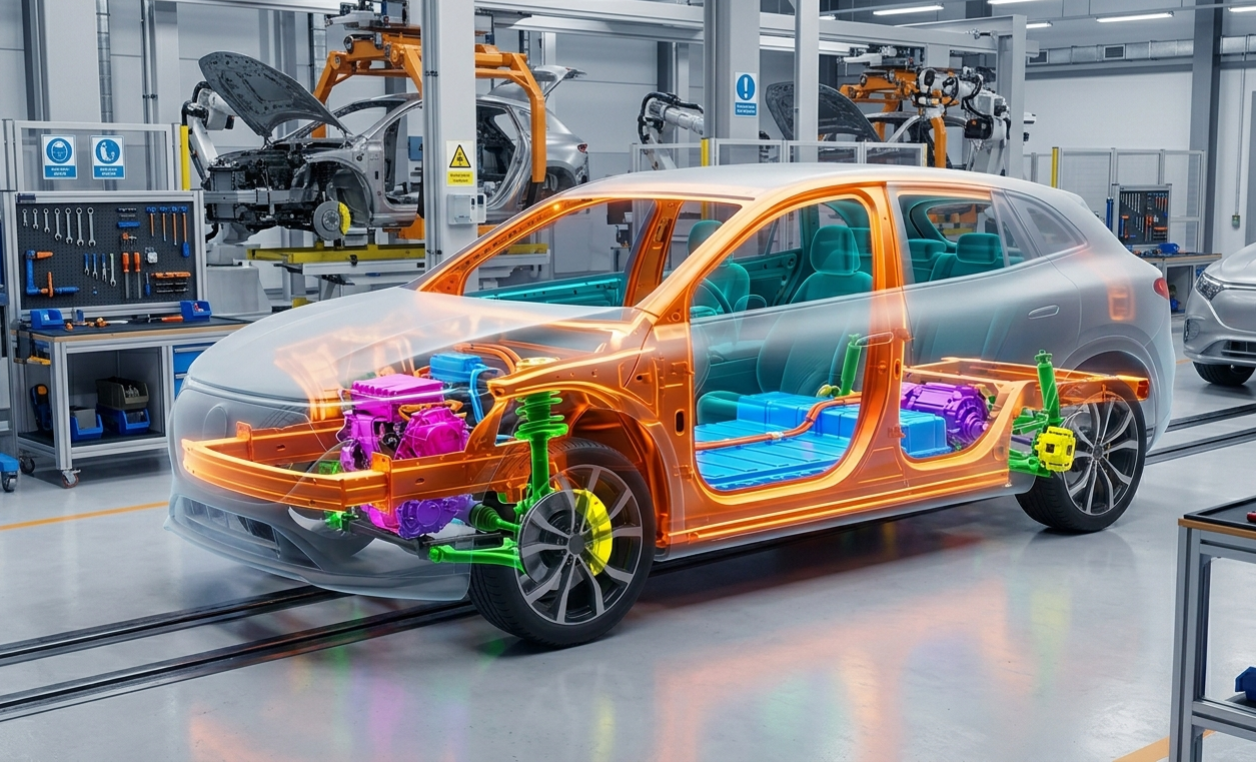
Chassis, Structural, and Load-Bearing Systems
Chassis and load-bearing systems define the vehicle’s structural backbone, carrying static and dynamic loads while ensuring stiffness, durability and crash performance. They are characterised by complex load paths, multi-axial stresses and tight interfaces between welded, bolted or cast components. A strong coupling exists between manufacturing processes and tolerances.
Development is challenged by competing targets for weight reduction, cost, structural integrity and manufacturability. Small deviations can lead to stress concentrations, misalignment or unpredictable system behaviour.
RD8 supports chassis and structural system development through Robust Design principles, focusing on kinematic architecture and interface definition, always maintaining tolerance optimization as a key ingredient of the product development.
This enables predictable load transfer, reduces overconstraints and creates designs that meet performance targets while remaining robust and production-ready at scale.
Mechatronic Systems for Autonomous and Safety-critical Applications
Mechatronic systems integrate precision mechanics with actuators and sensors, where interfaces, kinematics and tolerances directly impact car and passanger safety. They are characterised by tight coupling between mechanical architecture and control performance, minimal tolerance for variation, and strict lifetime requirements.
The development is challenging due to high sensitivity to geometric variation, reduced historical knowledge and very limited margin for late changes. Even small deviations can degrade system response or compromise function.
RD8 supports safety‑critical mechatronic systems by suplementing the SME knowledge with Robust Design principles, focusing on interfaces, kinematics and tolerance allocation. By eliminating overconstraints and reducing sensitivity early, RD8 enables predictable behaviour, fewer design iterations and robust, must‑not‑fail solutions suitable for autonomous driving at Level 3 or higher.

Propulsion and engine modules
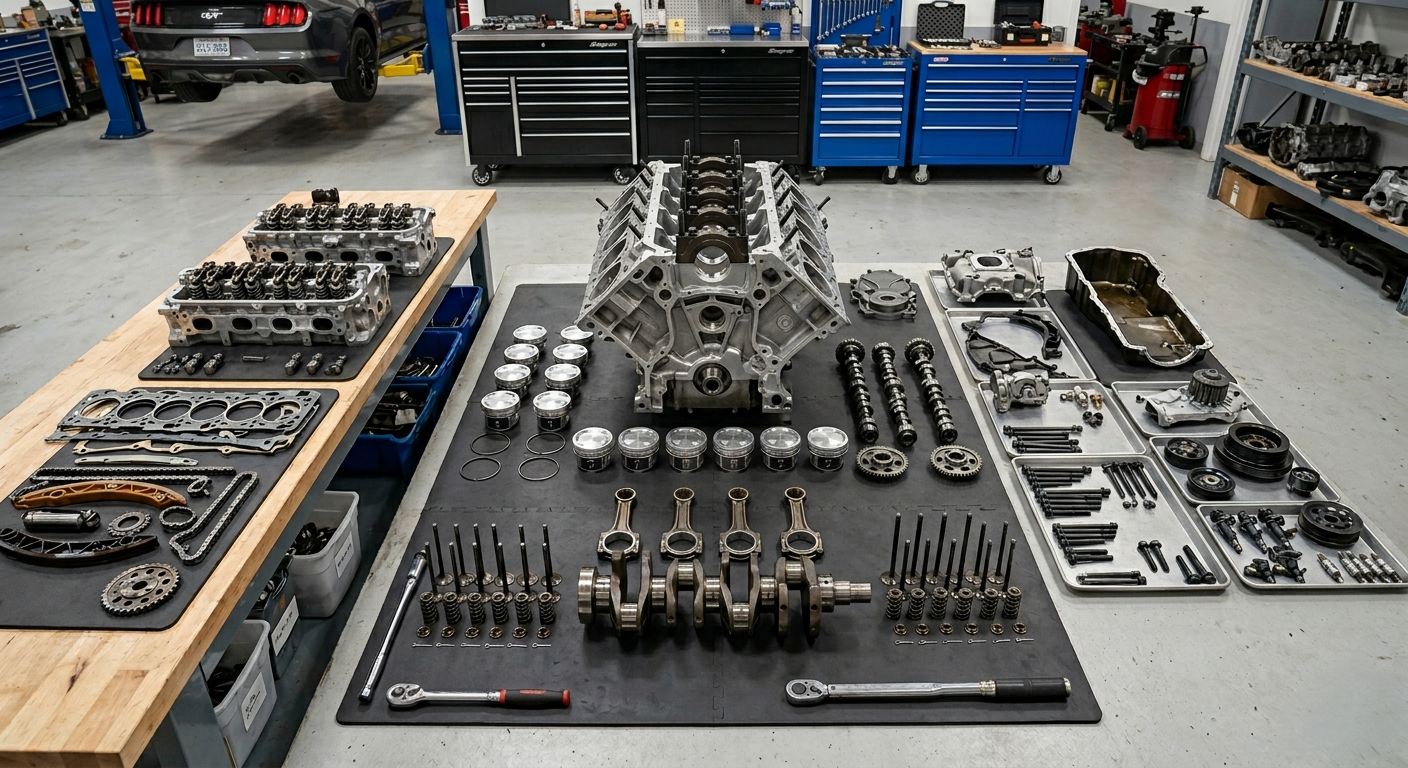
Propulsion and engine modules are dependent on complex load paths, rotating components, thermal effects and tight mechanical interfaces where efficiency, durability and NVH are critical. They combine high structural demands with sensitivity to assembly order and material behaviour under load and temperature.
Competing targets for performance, weight, cost and lifetime make development challenging, while small geometric deviations can lead to vibration, wear or reduced efficiency.
RD8 supports propulsion and engine modules through Robust Design principles, focusing on kinematic architecture, interface clarity and tolerance optimisation. This reduces sensitivity to variation, improves predictability and enables robust, production‑ready designs for high‑performance applications.
What mechanical engineering services are provided for Automotive Systems?
System Architecture Development
Mechanism and Structural Engineering
Tolerance and Variation Management
Robustness and Reliability Engineering
Failure Mode and Root-Cause Analysis
Design for Manufacturing (DFM)
RD8 supports automotive engineering teams throughout the complete design process
RD8 supports automotive product development across all stages by ensuring performance, durability, cost efficiency, and manufacturability from early concept through design, validation, and high-volume production.
1. Concept and System Architecture Development
2. Prototype Development and Early Validation
3. Design Maturation and Robustness Validation
4. Production Readiness and Scale-Up
What Engineering Approach Does RD8 Use for Automotive Product Development?
What results has RD8 delivered in Automotive engineering?
Ventilation Unit
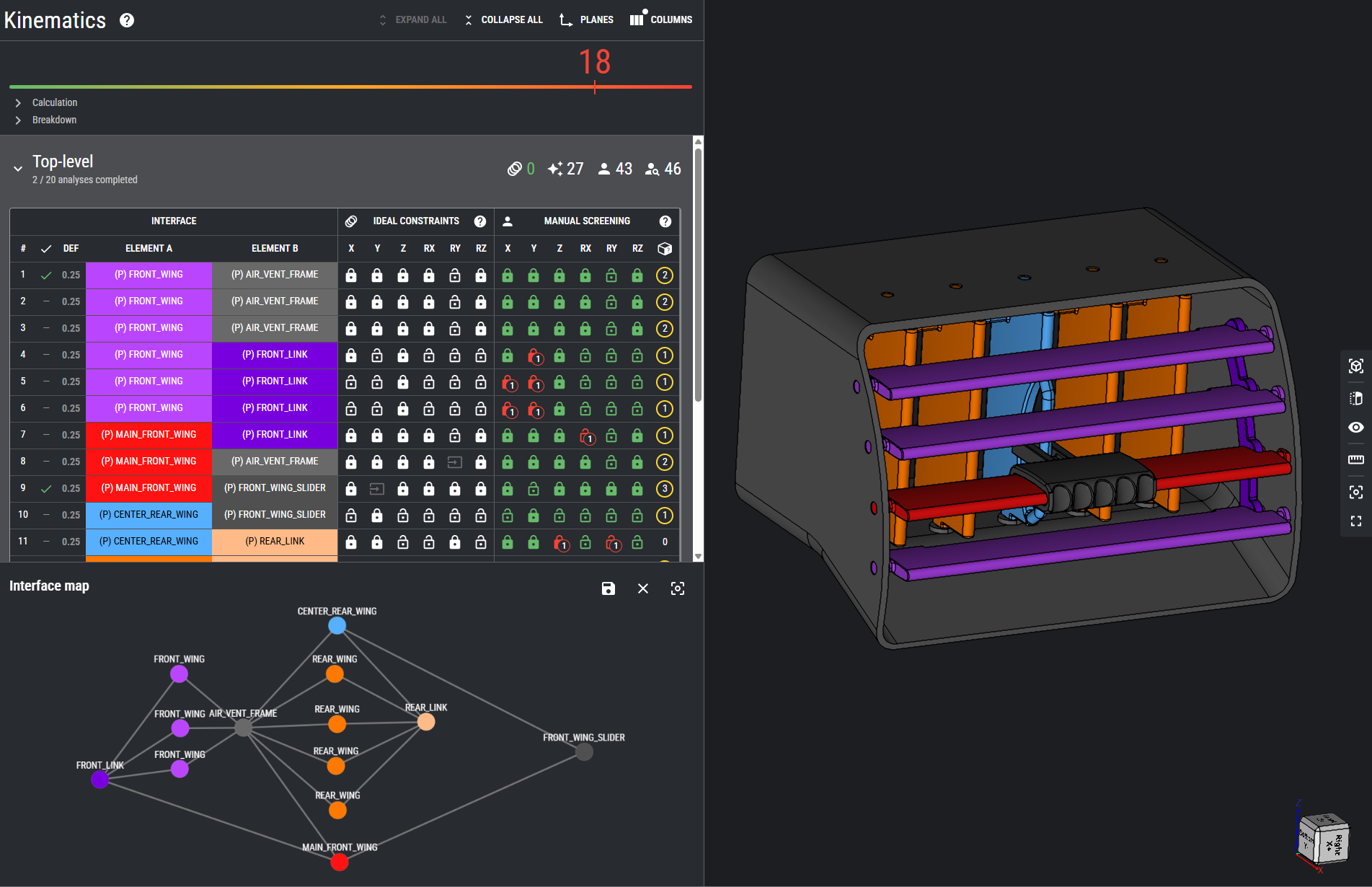
The RD8 Engineering Design Tool was used to evaluate and improve a center console ventilation unit by combining Kinematics and Tolerance analysis.
Early assessment with the RD8 tool identified overconstraints in the assembly, affecting airflow vanes and creating alignment risks under variation.
The original design required 14 parameters to control alignment between each rear wing and the center wing, achieving only 68% alignment success and introducing complexity and failure modes. Tolerance stack-ups were calculated to quantify these issues.
Interfaces were redesigned to ensure correct kinematics, reduce tolerance stack-ups, and simplify the concept. Reevaluation in RD8 confirmed improved robustness, reducing the kinematic score from 15 to 4
Applying robust design principles delivered measurable improvements:
Reinventing the Oil Pump
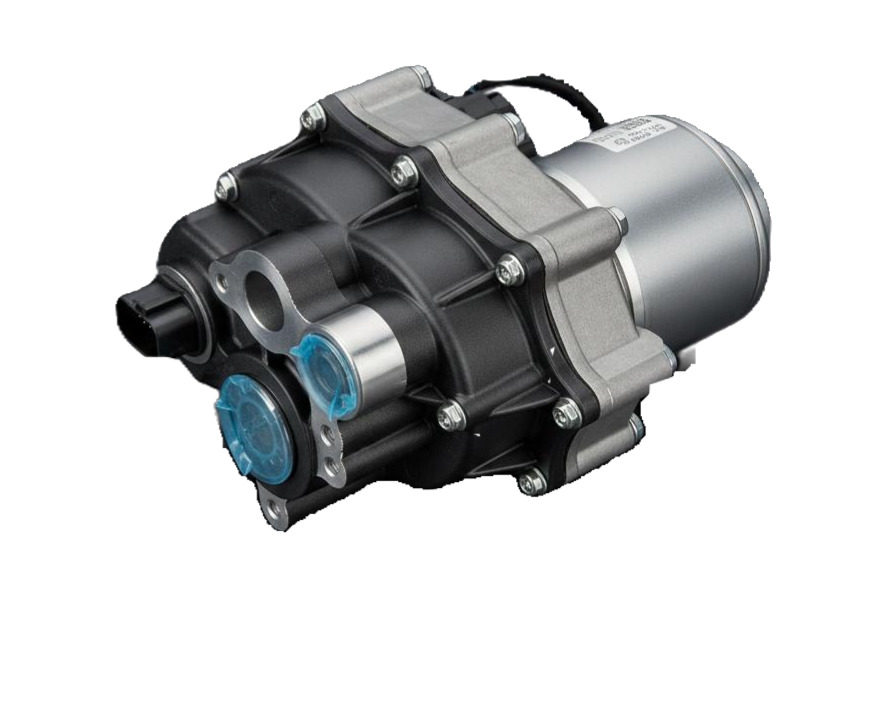
But as the automotive industry shifts towards electrification and efficiency targets, these legacy designs no longer meet new requirements. Higher integration, reduced energy losses, and compact packaging demand a fundamental redesign.
The challenge: unknowns in kinematics and force paths arise because the new design is not based on decades of experience.
These uncertainties cannot be solved by trial and error late in development. RD8’s approach identifies these risks early by mapping functional tolerance stacks and analyzing force paths from the concept stage. This enables engineers to validate robustness before tooling and deliver innovative solutions without prolonging the time to market.
By uncovering hidden variation issues early, RD8 ensures confidence in performance and cost targets, even when venturing into unfamiliar design territory.
Steer-by-Wire Steering Gear
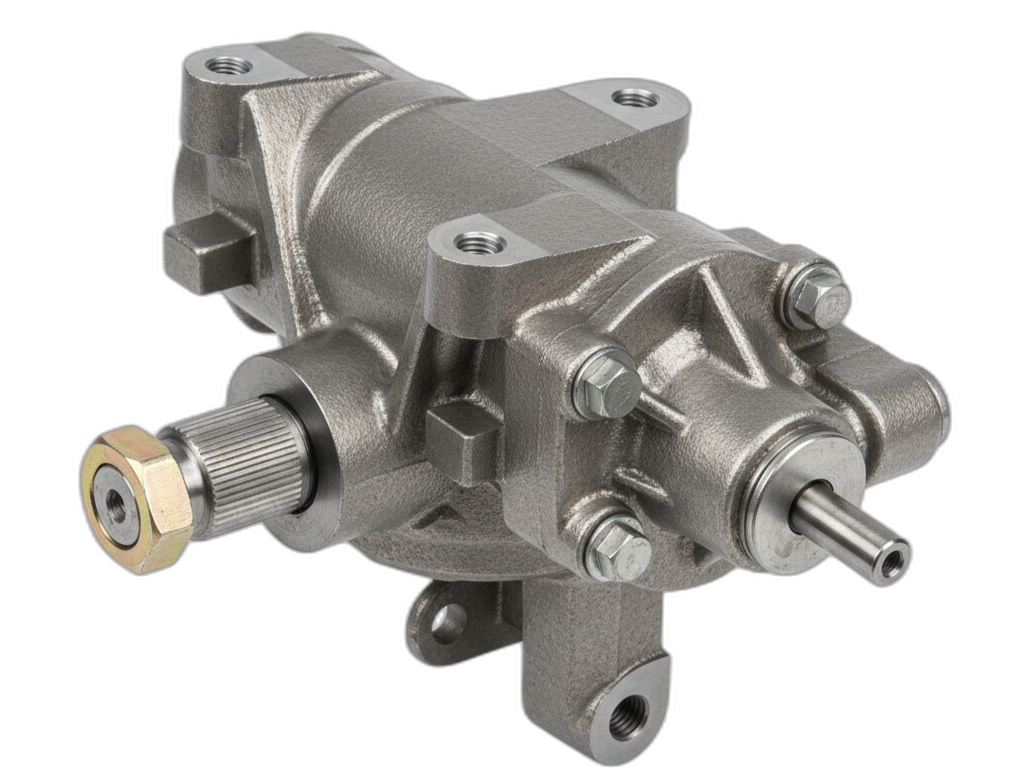
But this innovation introduces unfamiliar mechanical challenges. Without decades of field data to rely on, engineers face unknowns in force paths, tolerance behavior, and especially maximum load scenarios.
These systems are safety-critical and must perform flawlessly under every condition, such as curb-strike loads. When reliability cannot be guaranteed, OEMs add redundant backup systems, increasing weight, complexity, and introducing new potential failure modes.
RD8 addresses these challenges from the concept stage by mapping functional tolerance stacks and analysing force paths under normal and overload conditions. This allows engineers to identify and mitigate critical risks early, rather than relying on late-stage fixes.
The result is a more robust, optimized design with reduced complexity, minimized need for redundancy, and confidence that safety and performance targets are met without slowing development.
What Outcomes Does Automotive Engineering Consulting Help Achieve?
What Mechanical Engineering Expertise Does RD8 Bring to Automotive Development?
RD8 applies advanced mechanical engineering expertise to automotive products and modules, enabling reliable and predictable performance, minimized risk, and scalable manufacturability through systematic, data‑driven development
System Architecture and Interface Design Expertise
Tolerance, Sensitivity, and Variation Analysis Expertise
Assembly, Constraints, and Structural Engineering Expertise
Robustness and Reliability Engineering Expertise
Who Works With RD8 for Automotive Engineering and Product Development Consulting?
RD8 works with organisations across the complete value chain with Robust Design–driven engineering to improve product reliability, reduce development risk, and enable scalable, high‑volume production.
Automotive OEMs
Tier 1 and Tier 2 Automotive Suppliers
Electrification and Mobility Technology Companies
Engineering and Product Development Teams
How do teams work with rd8?
Why do teams work with rd8?
How Can You Start an Automotive Engineering Project?
1. Architecture and Design Assessment

2. Engineering Co-Development Engagement
3. Long-Term Product Development Partnership
Frequently Asked Questions About Automotive Engineering and Product Development Consulting
Find answers to the most common technical questions around Robust Design in the context of automotive product development.
How Does Robust Design and Mechanical Engineering Improve Automotive System Reliability?
Exact definitive answer
Provide a concise 2–3 sentence answer explaining how mechanical engineering improves automotive system reliability by controlling system behavior, minimizing variability, and ensuring consistent performance under real-world driving conditions.How mechanical engineering influences reliability (e.g., system design, material selection, load paths, durability engineering)?
How it reduces variability (e.g., tolerance control, robust design, variation analysis, process capability)?
What outcomes this enables (e.g., durability, reduced failure rates, consistent quality, lower warranty risk)?
What Engineering Challenges Exist in High-Volume Automotive Development?
Exact definitive answer
List definition + unordered list with descriptive list items.
What are the most common engineering challenges in high-volume automotive development?
How Do Tolerances Affect Cost, Performance, and Assembly in Automotive Systems?
Exact definitive answerProvide a concise 2–3 sentence answer explaining how tolerances influence automotive systems by affecting fit, alignment, force transfer, and assembly interactions, directly impacting performance, manufacturing cost, and assembly efficiency.How tolerances impact performance and assembly (e.g., fit, alignment, noise, vibration, assembly ease)?
What risks poor tolerance control creates (e.g., performance variability, increased scrap, assembly issues, higher? How engineering controls tolerances (e.g., tolerance stack-up analysis, variation control, robust design, process capability)?
How Are High-Volume Manufacturing Processes Managed in Automotive Design?
Exact definitive answerProvide a concise 2–3 sentence answer explaining how high-volume manufacturing processes in automotive design are managed by controlling variation, defining critical interfaces, and aligning product design with manufacturing capabilities to ensure consistent performance, quality, and cost efficiency at scale.How manufacturing processes are controlled in design (e.g., material selection, process selection, tolerance definition, critical-to-quality features)?
What challenges must be addressed (e.g., dimensional variation, tooling constraints, process capability, supplier variability, scalability)?
How engineering ensures performance and manufacturability (e.g., DFM/DFA, process validation, tolerance analysis, supplier integration)?
When Should Engineering Consulting Be Introduced in Automotive Development?
Direct definitive answer
Provide a concise 2–3 sentence answer starting with "Early," emphasizing that engineering consulting is most effective when engaged at the beginning of automotive development, while still delivering value at later stages when addressing performance, cost, durability, or manufacturability challenges.When is the ideal time to involve consulting (e.g., concept and system architecture phase)?
When it is still valuable later (e.g., during design refinement, validation, production ramp-up, or quality issues)?
What risks late involvement creates (e.g., redesigns, delays, increased costs, production inefficiencies, warranty risks)?
At What Stage of Development Can RD8 Support Automotive Engineering?
Exact definitive answer
Provide a concise 2–3 sentence answer stating that RD8 can support automotive engineering projects at any stage of development, from early concept through design, validation, and high-volume production.What stages can RD8 support?
What is the value of support across stages?
Why is flexibility important?
Does RD8 Offer Training or Engineering Academy Programs?
Direct definitive answerStart with "Yes" and clearly confirm that RD8 provides training, specifically mentioning advanced product robust design training.What training does RD8 provide?
Who is it for?
What outcomes does it enable?
Does RD8 Provide Software Tools for Tolerance and Robustness Analysis?
Direct definitive answer
Start with "Yes" and clearly confirm that RD8 offers tolerance analysis software, specifically mentioning tolerance stack-up analysis capabilities.
What software does RD8 offer?
What capabilities does it provide?
What value does it deliver?
Get in touch with our experts
Let's share viewpoints on next level design quality.
Shoot us a message and we will get back as soon as possible.


By submitting, you accept RD8's Privacy Policy and Terms of Service.