

Fewer test loops. Faster, data-driven decisions. Stronger outcomes.
The RD8 software allows easy and fast assessments, so you don’t need to wait for the parts from production, to know if you are on the right track.
Late Checks.
Costly Loops.
Uncertain Outcomes.
Tolerance and robustness reviews often happen at the very end of detailed design because they are time-consuming and complex. By then, the design space is limited, and changes ripple through multiple systems. The result?


The Hidden Cost of Late Checks
Most designs progress with only a handful of tolerance checks, often based on rules of thumb. Functional stacks involving multiple parts are rarely analysed early, leaving critical variation risks undiscovered.
At the final stage, reviews across all disciplines become a bottleneck and often just a checkmark that is ticked without understanding why these reviews are necessary.
Late discoveries force compromises, increase scrap rates, and inflate validation costs.
The underlying issue: robustness isn’t built in from the start. Without systematic coverage of all disciplines, designs remain unpredictable, and quality and performance are unknown until it’s too late.
Predictability from Day One
Robustness starts with the fundamentals: correct kinematics. By defining clear force paths and eliminating overconstraints early, RD8 ensures that systems behave predictably under real-world variation. Every interface is analysed for functional behaviour, so critical movements remain stable even when parts vary within manufacturing limits.
Equally important is understanding tolerance stacks from the first concept stage. Instead of relying on late-stage reviews, RD8 maps functional stacks early and across multiple components and sub-systems, so variation risks are exposed before they become costly. This proactive approach creates designs that are forgiving, manufacturable, and reliable, reducing redesign loops and accelerating time-to-market.
Robustness isn’t a one-time check but a continuous process. RD8 introduces design quality scores from the earliest sketches, tracking progress across all eight RD8 disciplines. These metrics highlight improvement trends and pinpoint weak areas before they become critical, enabling data-driven decisions at every milestone, not just at the end of every stage.
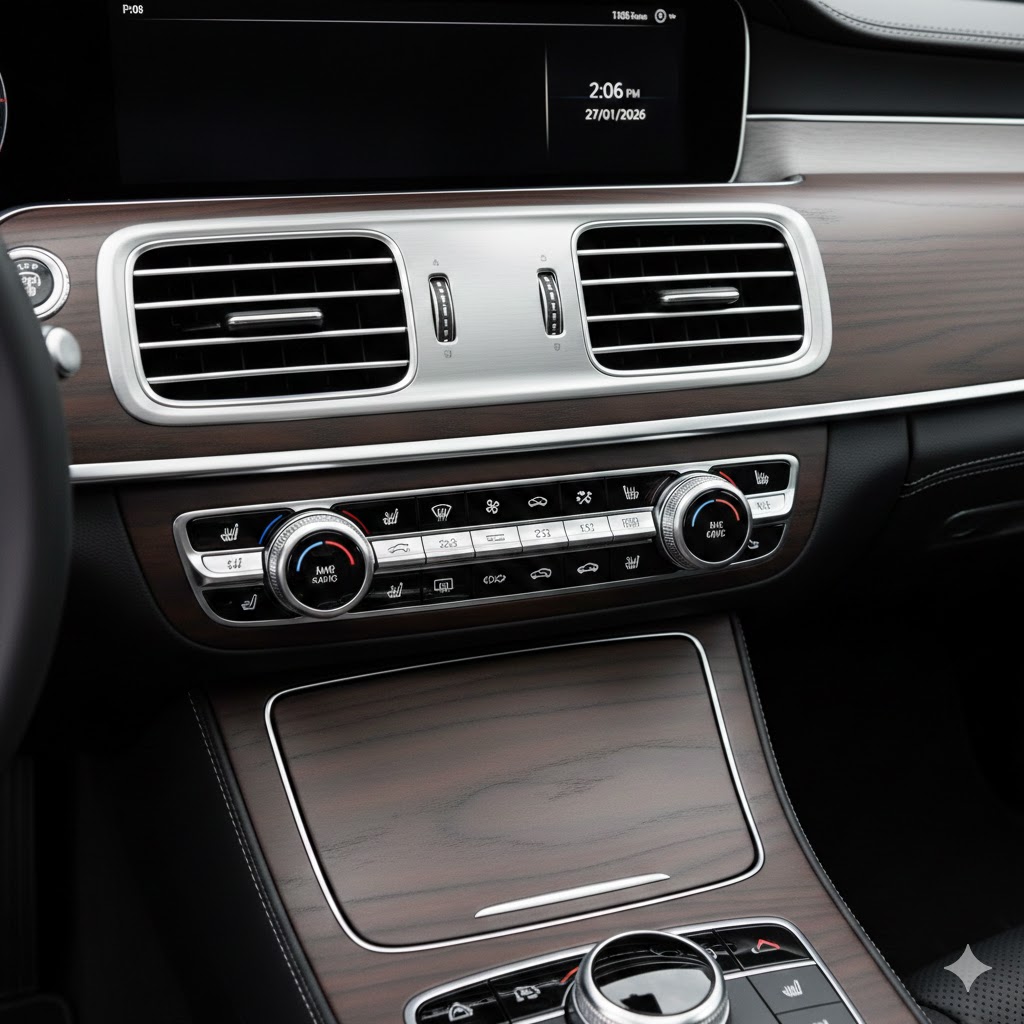
Ventilation Unit
Improving a centre console ventilation unit using the RD8 Engineering Design Tool
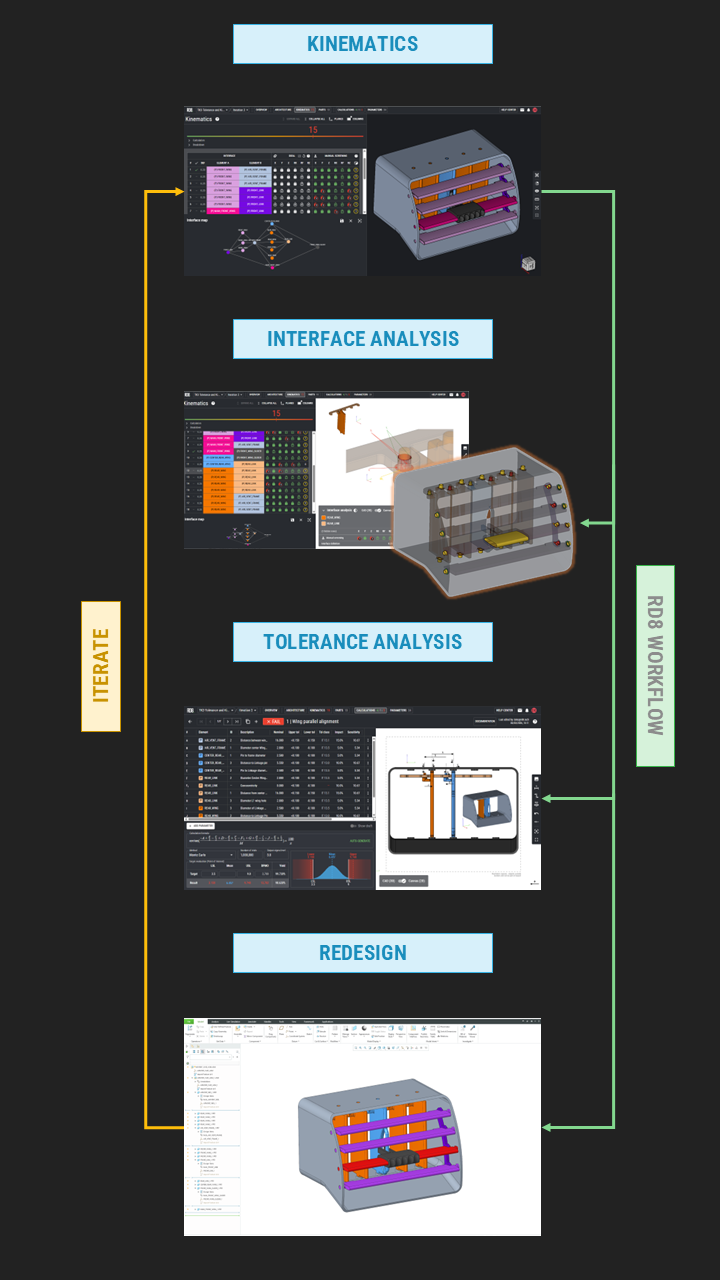
The RD8 Engineering Design Tool was used to evaluate and improve the design of a center console ventilation unit. By combining Kinematics and Tolerance analysis, critical design risks were identified early in development.
Kinematic Analysis
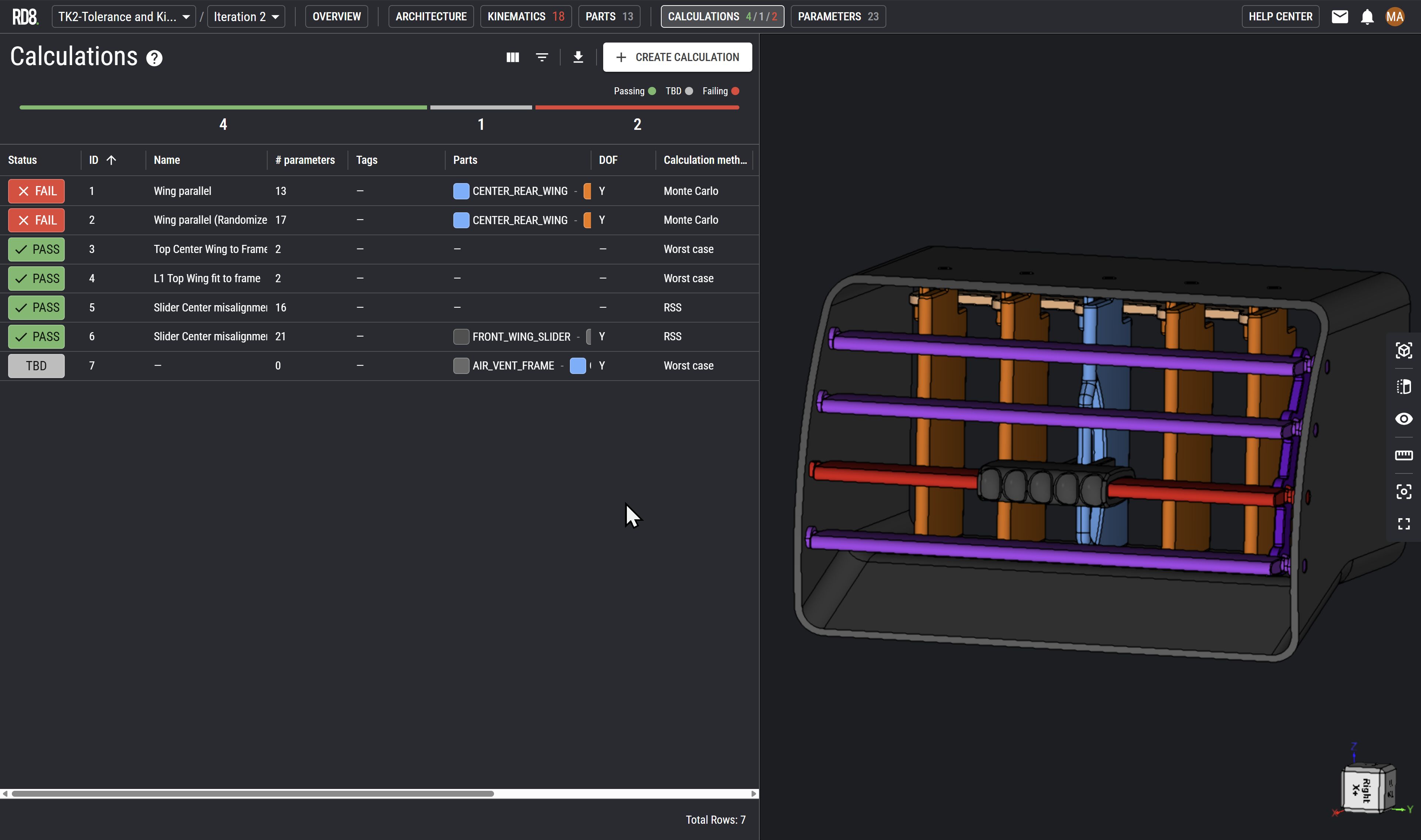
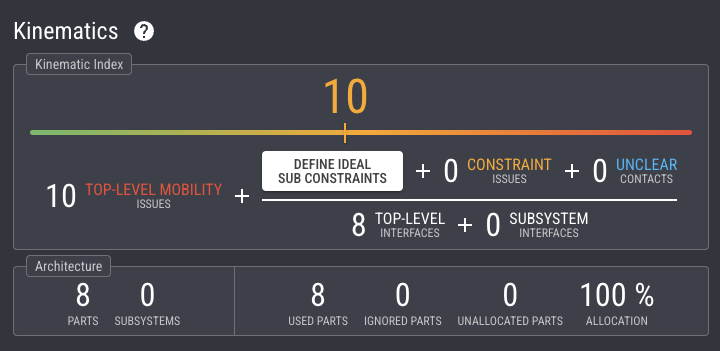
The RD8 tool revealed overconstraints in the assembly, affecting both the front and rear airflow vanes. Using the kinematic canvas, these overconstraints were clearly identified, highlighting potential alignment and functional risks due to variation. To assess their impact, several tolerance stacks were calculated.
Tolerance Analysis
Alignment between the rear wings and the centre wing is critical to product performance. The existing design required 14 parameters to define the alignment between each of the rear wings and the centre wing, resulting in only 68% successful alignment. Repeating this analysis for each wing increased complexity and introduced additional failure modes.
Redesign and reevaluation
With a clear understanding of the root causes, interfaces were redesigned to ensure correct kinematics, reduce tolerance stacks, and simplify the overall concept. The improved design was reevaluated in RD8 to confirm robust performance, lowering the kinematic score from 15 to 4.
Impact
Applying robust design principles delivered measurable improvements:
Get in touch with our experts
Lets share viewpoints on next-level design.
Want to know more about:
Shoot us a message and we will get back as soon as possible.


By submitting, you accept RD8's Privacy Policy and Terms of Service.